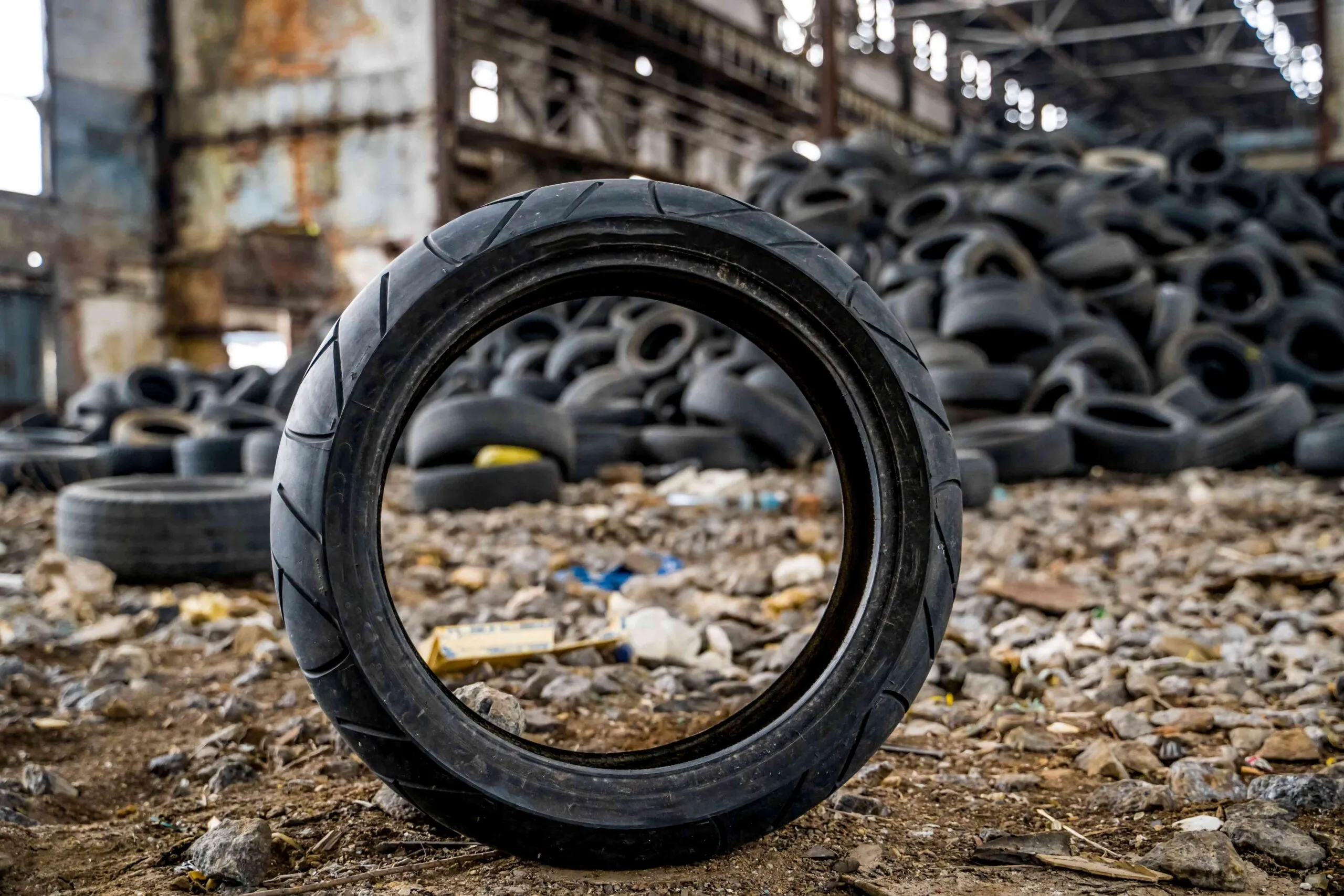
Across ASEAN, tyre recycling is rapidly evolving from informal, low-value disposal into a more sophisticated, technology-driven sector. Countries such as Thailand, Vietnam, and Indonesia are moving ahead with industrial-scale production of crumb rubber, pyrolysis outputs, and recovered carbon black as their governments strengthen environmental rules and embed circular-economy principles into national policy.
Tyre Recycling Gains Momentum in ASEAN
These shifts reflect a broader regional trend: according to Cognitive Market Research, the Asia-Pacific tyre-recycling market was valued at around USD 2.86 billion in 2024, while global forecasts suggest a mid-single-digit CAGR through the late 2020s. The market signals a growing appetite for tyre-derived products and recycling services—and ASEAN nations are responding decisively.
ASEAN’s experience shows that technology alone is not enough. Thailand and Vietnam have scaled up crumb rubber and recovered carbon black production to meet domestic and export standards, supplying materials for sports surfaces, industrial mats, and road construction. Their success highlights that consistent feedstock, proper emission controls, and adherence to quality standards are essential for turning tyre waste into a profitable, environmentally responsible business.
Malaysia sits at an important inflection point. The country imports RM3.53 billion worth of tyres annually and generates roughly 22 million used tyres each year, yet still lacks a cohesive national system to manage end-of-life tyres. This gap was highlighted in Parliament recently, where questions were raised about how tyre waste is being handled and whether Malaysia is effectively capturing the economic value of discarded materials. Deputy Minister of Plantation and Commodities (MoPC) Datuk Chan Foong Hin explained that agencies such as the Malaysian Rubber Board (LGM) and Malaysian Rubber Council (MRC) are developing solutions involving recovered carbon black, devulcanised rubber, and tyre-derived materials for road works, bricks, mats, footwear, and building products. Funding programmes including the Automation and Green Technology initiative and MRC commercialisation funds are supporting greener manufacturing, such as a pre-cast wall panel embedded with crumb rubber now in pre-commercial trials.
Yet these innovations have not addressed the most fundamental challenge: tyre shops across the country still struggle to dispose of waste tyres, with waste collectors frequently refusing to pick them up. Kota Melaka MP Khoo Poay Tiong raised this issue in parliament, prompting Chan to clarify that waste management falls under the Ministry of Natural Resources and Environmental Sustainability (NRES), not MoPC—a clear illustration of Malaysia’s fragmented end-of-life tyre governance.
Structural Challenges
Industry experts echo these concerns. Dato’ Lee Chun Seong, Managing Director of Alantac Engineering Sdn Bhd, emphasises that Malaysia’s tyre recycling sector cannot stabilise without addressing deep structural weaknesses. The absence of a mandatory, centralised collection system leaves feedstock flows inconsistent and easily diverted to unlicensed operators. Enforcement remains uneven, illegal processing persists without consequence, and Malaysia lacks a complete tracking mechanism or a closed-loop framework connecting the Department of Environment, local councils, and industry players. This creates a market where compliant recyclers bear higher costs while non-compliant operators undercut prices, deterring investors from entering a sector with unpredictable rules and returns.
Lee points to Taiwan and Japan as models. In these countries, tyre recycling thrives under strict Extended Producer Responsibility regimes. Every tyre produced or imported is accounted for; collection is government-controlled; tracking systems ensure zero leakage; and compliant facilities receive stable, fairly priced feedstock. “If Malaysia moves toward such a high-control model, the ELT recycling sector can finally become sustainable, environmentally responsible, and profitable,” Lee notes, highlighting that structural reform, rather than technology alone, is key to unlocking the industry’s full potential.

Despite these challenges, Malaysia is not without positive examples. A local crumb rubber and rubber granule producer, such as Green Rubber & Petroleum, demonstrates the possibilities when compliance, investment, and market demand align. Through significant spending on emission controls, automation, and internationally recognised product certification, the company has achieved export-ready quality. Its operations are supported by long-term feedstock contracts, a culture of regulatory compliance, and the capability to meet sports-surface and industrial performance standards. Importantly, the company has invested in downstream applications such as tiles, mats, and playground materials, allowing it to move up the value chain rather than competing solely on volume. This example shows that Malaysia can compete regionally when the right conditions exist.
Reviving Pyrolysis Plants
The contrast with parts of the pyrolysis sector is stark. Several Malaysian pyrolysis plants have faced closure after complaints about odour, smoke, substandard emissions, and low-quality oil. Issues such as unlicensed expansion and poor process control have further damaged the industry’s reputation. However, at least one operator has proven that the technology can be rehabilitated. By retrofitting its facility with standardised kilns, activated carbon scrubbers, continuous-feed systems, and automated condensation lines, the plant has significantly reduced emissions while improving the consistency of its oil output. This transformation demonstrates that pyrolysis can shift from being perceived as a “dirty industry” to a credible circular-economy contributor—but such upgrades require substantial capital and are only viable when regulations and market conditions are clear, stable, and consistently enforced.
Malaysia’s tyre recycling industry is therefore at a crossroads. ASEAN neighbours are moving forward with clearer policies, stronger controls, and growing industrial capacity, supported by a regional market now worth billions of dollars. Malaysia has the technological foundation, local expertise, and successful pilot cases to catch up, but only if it strengthens governance, stabilises feedstock flows, and creates a predictable regulatory environment that rewards compliance rather than tolerating non-compliance. Without such reforms, Malaysia risks falling behind just as the region accelerates into a more circular and resource-efficient future.