Michelin has begun Phase II operations at its Shanghai plant, following a RMB 3 billion investment under the White Magnolia Project.
Phase II Focuses on High-End and New-Energy Vehicle Tyres
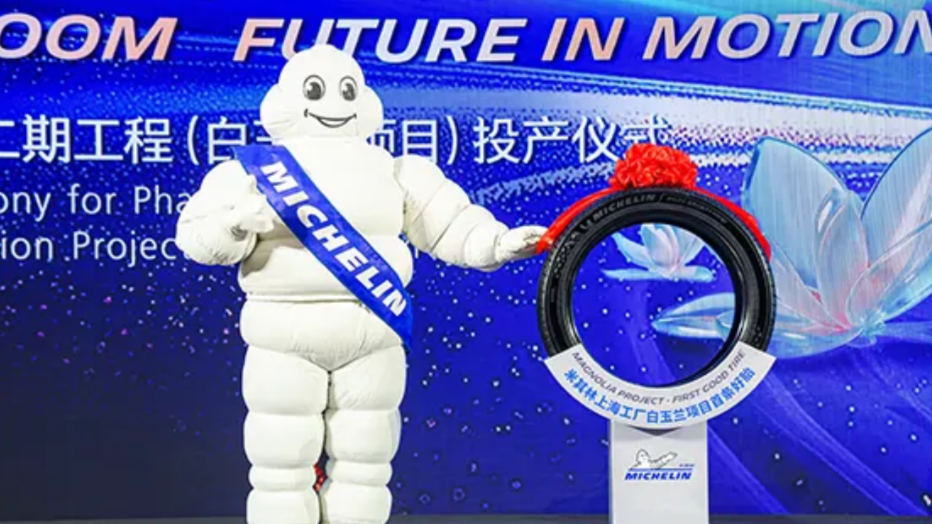
Michelin has begun operations at Phase II of its Shanghai plant expansion, marking a further RMB 3 billion (£314.9 million) investment in the facility known as the White Magnolia Project.
The start of the operations was confirmed on January 23, 2026, alongside the roll-off of the first tyre produced under the new phase, the Michelin Primacy 5E, which the company described as a high-performance green tyre.
The expanded Shanghai plant is the first of Michelin‘s so-called “Future Factory” facilities to be realised in China. The project was developed with support from the local government and in collaboration with industry partners, focusing on electrification, intelligent systems, and higher-end vehicles.
The White Magnolia Project is designed to concentrate on 18- to 24-inch passenger car tyres, with around 70 per cent of capacity intended for new-energy vehicles. With Phase I already operational, the Shanghai plant increased its annual capacity by 1 million tyres and introduced more than 100 high-end product specifications. Total annual capacity at the site has now reached 9.5 million tyres, with a product range of more than 360 SKUs.
Michelin said the expansion is intended to support a more flexible production model as the industry shifts towards smaller batch sizes, faster response times, and greater customisation.
Each tyre forming machine at the upgraded plant is capable of producing one tyre every 36 seconds, while also handling production runs as small as 100 units. Order delivery cycles have been reduced to as little as five days, a move aimed at meeting the speed requirements of China’s original equipment tyre market.
Sustainability is positioned as a core element of the project. The Shanghai facility operates with fully electrified production and uses vulcanisation equipment, which Michelin claimed offers more than four times the energy efficiency of traditional steam-based systems. The plant is supplied entirely by clean energy and has invested RMB 30 million (£3.15 million) in green infrastructure, including systems that enable 100 per cent water recycling and further reductions in emissions.
Digitalisation and artificial intelligence are the other highlights of the new phase of the Shanghai plant. According to the company, data-driven manufacturing management systems are used to improve construction efficiency, accelerate production ramp-up, and shift operations from reactive maintenance to predictive management, with the goal of reducing trial-and-error costs while ensuring stable and consistent product quality.
Michelin entered the mainland Chinese market in 1989 and has since expanded its manufacturing footprint alongside the country’s auto industry.
“This factory represents more than just an increase in manufacturing capacity, but also a concrete embodiment of Michelin’s vision of ‘All Sustainable’. It is intended to support the production of tyres designed to improve safety, comfort, and sustainability for Chinese consumers,” the company said.