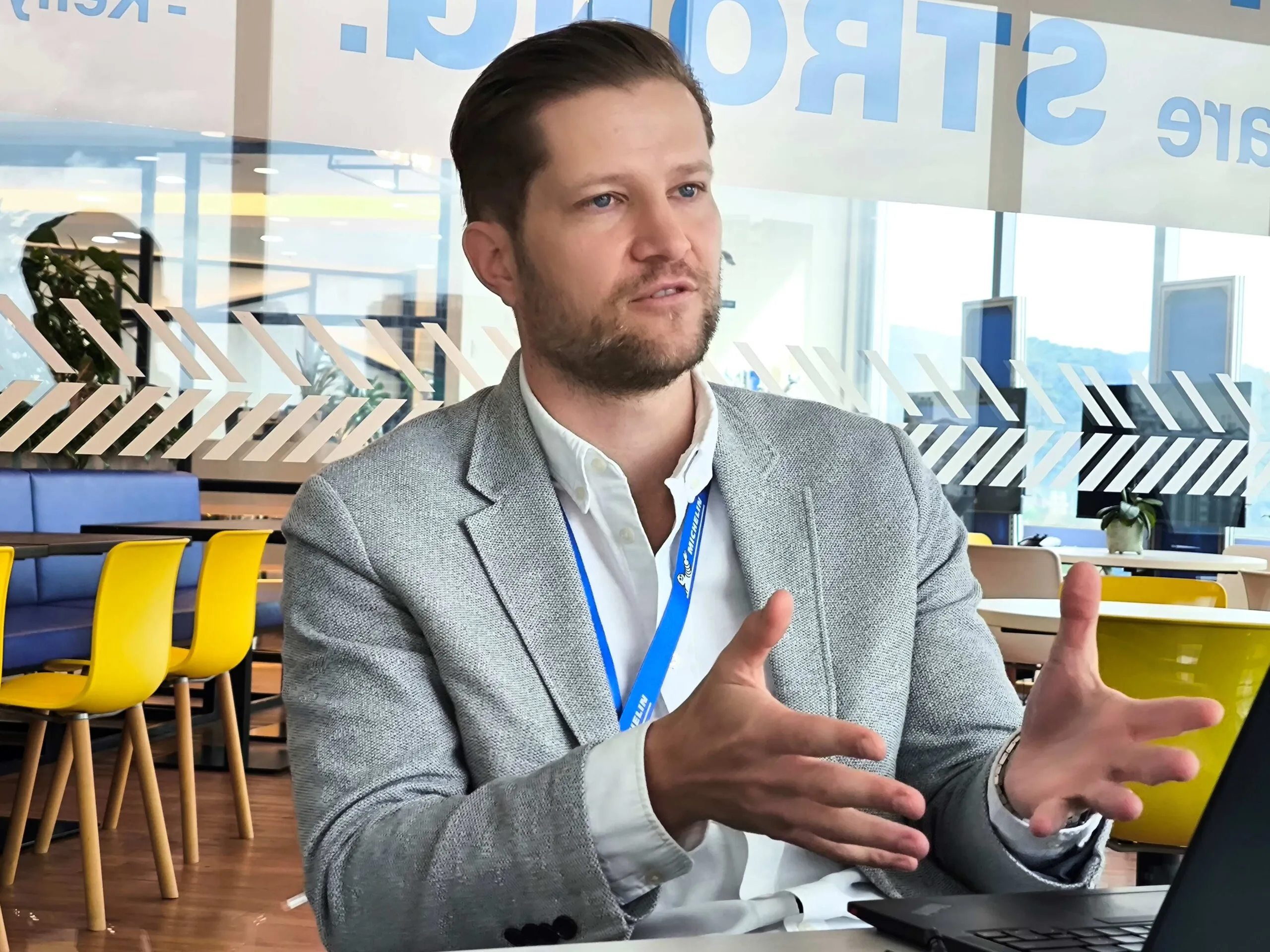
Florentin Odenwald, the recently appointed Managing Director of Michelin in Malaysia, Singapore and Brunei, describes the company’s priorities in the region as centred on helping consumers better understand tyre performance, strengthening digital access while maintaining professional retail channels, and preparing for long-term shifts in mobility and sustainability.
Odenwald’s Mission: To Show Why Michelin Can Make A Difference
Odenwald is careful not to disclose specific strategy, but his main objective is clear. “What we want to do is we want to show why Michelin can make a difference,” he says. Tyres remain a difficult product category for consumers, who are unable to test them before purchase and generally experience their performance only in demanding situations such as emergency braking or challenging road conditions. As he notes, tyres “all look the same” and the perceived differences are often limited to the price tag. Michelin’s priority is therefore to communicate more tangibly the performance advantages it offers, particularly in areas such as braking distance, wear and abrasion.
The challenges faced by a premium tyre manufacturer in Malaysia, Singapore and Brunei mirror those in mature markets. According to Odenwald, consumers everywhere have the same question: “What do I actually get?” The value proposition, he argues, is strong once safety, longevity and performance are factored in but conveying that value effectively to the consumer remains a core task.
Digitalisation and E-commerce: Opportunity and Complexity
E-commerce plays an increasingly significant role in tyre retail across Southeast Asia, accelerated by the strong presence of platforms such as Shopee. “When I came here, I was really surprised how strong Shopee is,” Odenwald remarks. The growth of online marketplaces expands access to Michelin products and has already prompted the company to begin listing selected ranges, starting with two-wheeler tyres.
However, digital retail introduces new complexities. Effective tyre selection requires technical accuracy, and consumers can easily be overwhelmed by the variety of sizes, fitments and specifications. Differentiating between tyre lines or identifying the correct fitment for vehicles with mixed front and rear axle requirements can be challenging even for experienced drivers. Odenwald acknowledges that transferring the role of an in-store expert to an online environment remains a substantial task.
Michelin’s approach is to ensure that its official e-commerce presence, whether on Shopee, Lazada or other channels, provides clear and accurate information to support consumer decision-making. Yet Odenwald recognises that face-to-face advice will remain necessary. Tyres require professional installation, ensuring inevitable contact with authorised fitters, where consumers can still receive guidance. For Michelin, online and offline retail “go hand in hand.”
The rise of digital information tools, including AI, has also changed how consumers research tyre options. While these technologies offer easier access to information, Odenwald points out that accuracy remains a concern: “Are you sure the information is all true? That is the problem with AI.”
EV Readiness as Standard
With the rapid global adoption of electric vehicles, tyre requirements are evolving. EVs typically feature higher vehicle weight and greater torque, creating new demands for tyre design. Michelin has positioned itself by ensuring all its tyres are suitable for EVs. “We design products… so all our tyres are suitable for EV,” Odenwald emphasises. This approach is intended to simplify choices for consumers who may own a combustion vehicle today and an EV tomorrow, while maintaining energy efficiency through optimised rolling resistance.
For the region, the central question regarding EVs is one of timing rather than direction. Markets such as the Nordic countries already see EV dominance, while Southeast Asia is expected to transition more gradually. Michelin’s strategy aims to keep pace with developments by ensuring compatibility across its entire range.
Sustainability Considerations
Sustainability remains a global priority for Michelin. Odenwald notes that longevity and low abrasion have long been part of the company’s product DNA. Recent studies, including those conducted by ADAC in the context of Euro 7, show Michelin with a 25 per cent advantage over competitors in tyre abrasion — a key contributor to micro-particle pollution. Reducing road-tyre wear particles is an area of sustained investment for Michelin, which seeks to minimise environmental impact while maintaining performance and safety.
The company’s sustainability framework is built around its four-pillar approach: reduce, reuse, recycle and renew. This includes efforts to extend casing life and optimise materials, with ongoing research into compounds that reduce wear rates without compromising structural requirements. Addressing abrasion is seen as essential given the physics of tyre-road interaction, an issue affecting all manufacturers globally.
Retreading in Asia
Retreading plays a significant role in Michelin’s sustainability ambitions, though its development varies across regions. In Asia Pacific, success depends on local infrastructure, road conditions and operational practices. Michelin already operates certified aircraft tyre retreading in Thailand, reflecting the stringent quality requirements of aviation customers.
For road transport, the challenge is ensuring that retread products are adapted to regional conditions, including varied tarmac quality, potholes and vehicle maintenance standards. Strengthening retreading contributes to emissions reduction by extending the lifespan of casings, an area in which Michelin designs its tyres to be particularly durable.
Distribution and Tyreplus Expansion
Michelin continues to invest in its Tyreplus retail network alongside its digital expansion. The network has grown to 125 stores in Malaysia, with further expansion expected. Maintaining quality standards across the network is a priority, supported by ongoing investment in service delivery. Odenwald notes that Tyreplus is among the highest-rated retail networks in the country, and Michelin aims to preserve this position as it grows. Partner engagement is strong, with several opening multiple stores each year.
Market Integrity and the Importance of Authorised Dealers
Recent enforcement actions by the Malaysian Anti-Corruption Commission (MACC), involving suspected smuggling and documentation issues in the tyre sector, have raised questions about market integrity. Michelin was contacted by authorities only after the raids to verify tyres in question. According to Odenwald, all tyres inspected appeared to be genuine Michelin products with valid certificates, and he has yet to encounter a counterfeit Michelin tyre due to the difficulty of replicating its design and manufacturing processes.
The main issue lies in ensuring that tyres imported into Malaysia are suitable for local conditions. Michelin emphasises that authorised dealers guarantee appropriate product selection. As Odenwald explains, while a winter tyre designed for Nordic conditions could be legally imported and used in Malaysia, it would not offer optimum performance.
Warranty considerations further underline the importance of authorised channels. Michelin can verify authenticity through barcodes embedded in the bead area, but in cases where barcodes have been removed, the company cannot confirm origin, creating uncertainty for both the brand and the consumer. “That’s why you should only buy from authorised dealers,” Odenwald says, noting that dealer lists are available on Michelin’s website.