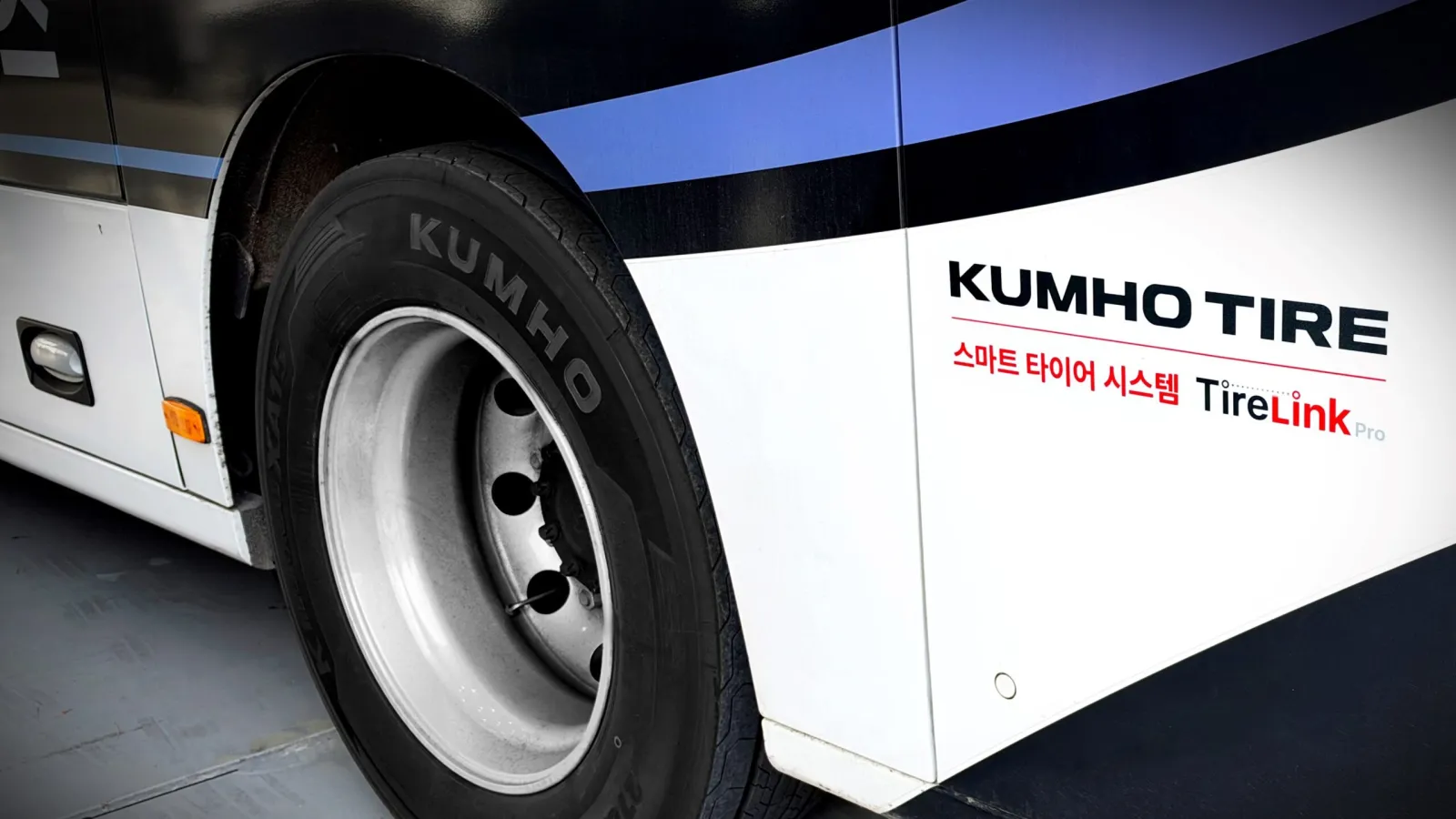
Kumho Tire has announced a collaboration with autonomous vehicle specialist SUM to deploy its smart tyre system on autonomous buses in Seoul, marking the first real-world use of tyre condition data management technology in a driverless bus environment. The initial scope covers the Seoul City Dawn Companion autonomous bus service and the Dongjak District autonomous village bus.
Kumho Tire Partners with SUM to Advance Data-Driven Fleet Management for Autonomous Transit
Kumho Tire will apply its smart tyre system alongside its commercial vehicle OE tyres, the KXA15 and KRS03, on the target vehicles. SUM will provide the actual autonomous bus operating environment and verify the practical utility of tyre sensor data collected during operation. The two companies plan to combine their respective tyre technology and autonomous driving operational capabilities to develop concrete data-based fleet management approaches.
The smart tyre system uses a sensor module fitted inside the tyre and an in-vehicle wireless communication unit to measure and monitor key tyre condition data in real time while driving, including tyre pressure, temperature, wear, and dynamic load. The technology is designed to improve driving safety and tyre management efficiency, contributing to lower operating costs.
The importance of real-time tyre monitoring is amplified in autonomous vehicles, which minimise driver intervention and rely on the vehicle itself to assess and control driving conditions. Integrating tyre data with the vehicle system is seen as a meaningful way to enhance both the safety and operational efficiency of autonomous vehicles.
Based on the results from the Seoul pilot, Kumho Tire and SUM plan to expand the smart tyre application to autonomous bus projects nationwide. Seoul City itself is pursuing the introduction of 500 autonomous city buses by 2030, providing a clear commercial pathway for the technology.
Kim Young-jin, Executive Vice President and Head of R&D at Kumho Tire, said a smart tyre’s value grows when its data is put to practical use. “The value of a smart tyre grows greater when tyre condition is accurately identified in actual operating environments, and that information is used in vehicle management,” he said.
“Through this pilot, we will verify the effectiveness of data-based management technology on autonomous buses in central Seoul, and on that basis expand the scope of application to the nationwide autonomous bus market while continuing to develop technology that can be integrated with autonomous driving systems,” he added.
Kumho Tire said it is also reviewing the applicability of its smart tyre technology with domestic city bus operators and rubber-tyred AGT (Automated Guideway Transit) operators, expanding its collaboration ecosystem through field pilots and technical cooperation. This forms part of the company’s broader push to commercialise smart tyre technology for the autonomous and smart mobility era.